Valencià
 Español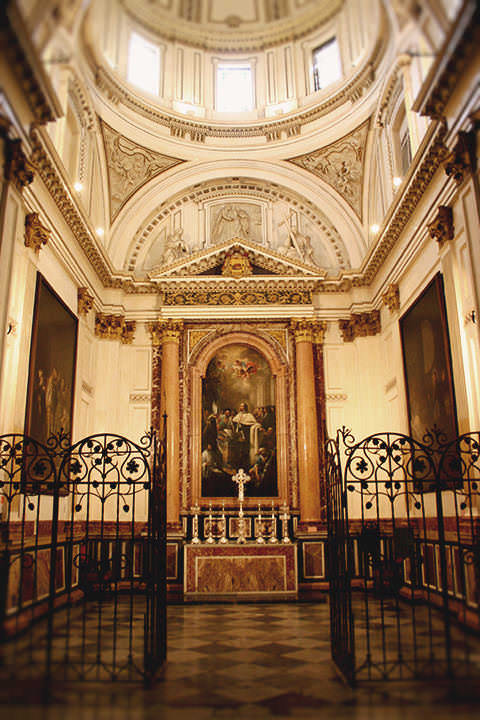
Key information
Chapel of Saint Francis of Borgia
High altar
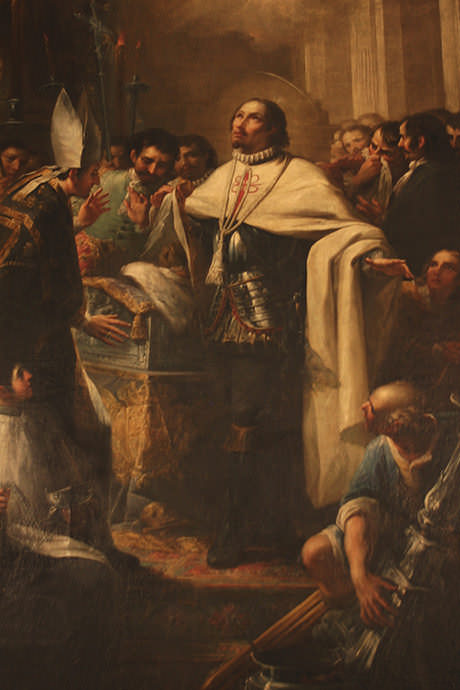
Saint Francis Borgia
before the dead body of the Empress Isabella Oil painting by Mariano Salvador Maella
(1739-1819)
Painted in 1787.
Dressed as a knight of The Order of Santiago, he raises the cloth which covers the face and the hands of the body of the Empress and feels the calling of God to leave the vanities of the world.
Over the high altar
Stucco
Saint Francis joins the Society of Jesus.
Panel painting,
Coat of Arms of the Borgia family.
Statues on the high altar
Stuccoes
Allegories of the Prayer (with arms folded)and the Penance (with a scourge and a cross).
Left side
Saint Francis Borgia Oil painting by Francisco de Goya
(1746-1828)
Painted in 1788.
Saint Francis Borgia saying goodbye to his relatives to join the company of Jesus.
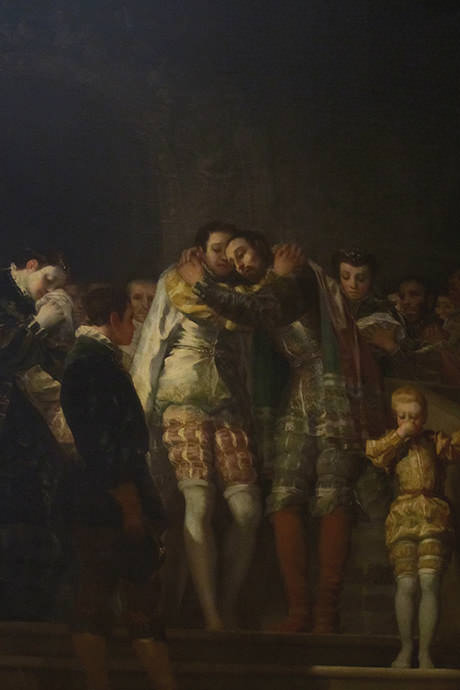
Right side
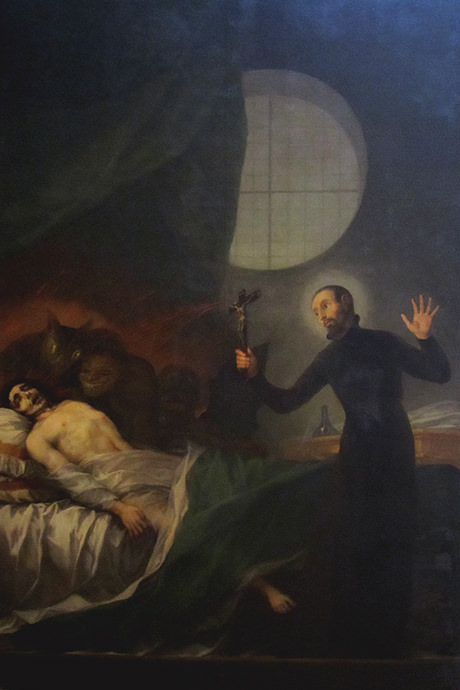
Saint Francis Borgia Oil painting by Francisco de Goya.
Painted in 1788.
Saint Francis Borgia – already a Jesuit priest – attending to an impenitent dying man. The Blood of Christ protects the sinner from the devils which expect to steal his soul.
Pendentives of the dome/h4>Stuccoes
Allegories of the Temperance, the Fortitude, the Correctness and the Righteous Justice.
Francis Borgia (Gandía 1510 – Roma 1572), Duke of Gandia and Marquis of Llombay, was from the family of the Valencian Popes Callixtus III (Alfonso Borgia) and Alexander VI (Roderic Borgia) Charles V made him responsible for carrying the body of the Empress Isabella to Granada, Spain. The sight of the corpse inspired him to “not serve a Lord who might die”.When his wife died (1546), he decided to join the Society of Jesus, recently founded by Saint Ignatius of Loyola. Ordained priest in Rome (1551) and as Third General of the Jesuits (1565), he promoted missions and the education centres, such as the Gregorian University of Rome. His feast day is celebrated on October 3.