Valencià
 Español
The Reliquary
The relics of the Cathedral of ValenciaThe Reliquary of the
Cathedral of Valencia
The Church venerates only authentic relics, because they bring us closer to the memory of the Saints, whose bodies are destined to resurrect gloriously; and respectfully preserves the historical ones, for the traditions that they testify, the memory of the people who worshiped them and also for their artistic value.
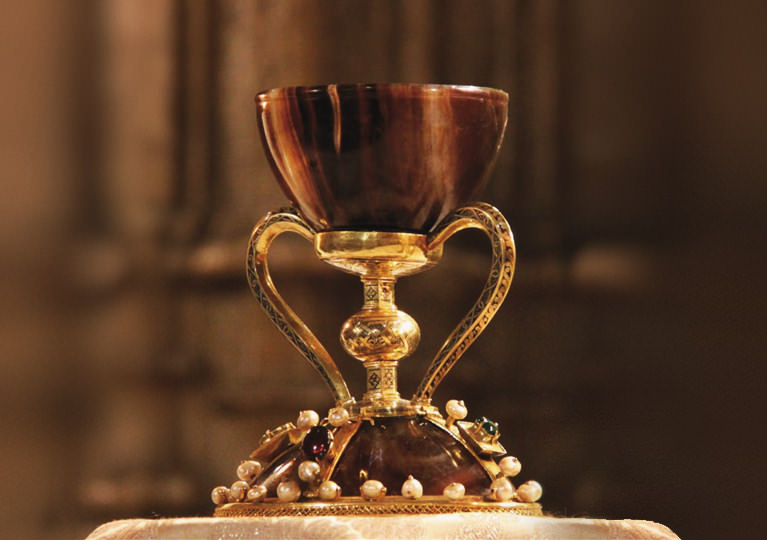
In the 15th century, specifically the year 1437, King Alfonso V the Magnanimous gave the Cathedral of Valencia the reliquary of the Crown of Aragon, among whose treasures the Holy Chalice of the Last Supper of the Lord stands out, which had been preserved in the Monastery of San Juan de la Peña (Huesca) until 1399.
View history, the chapel of the relics and the relics in the museum
History
Valencia Cathedral had a authentic treasure of reliquaries, many of them representing the Saints in full length or just the bust.
Most of them were melted in 1812, in Mallorca, where they had been transferred, together with the silver altarpiece and the Gothic processional custody, in order to save them from the rapacity of the French army; all this was converted into coins to pay the troops fighting against Napoleon.
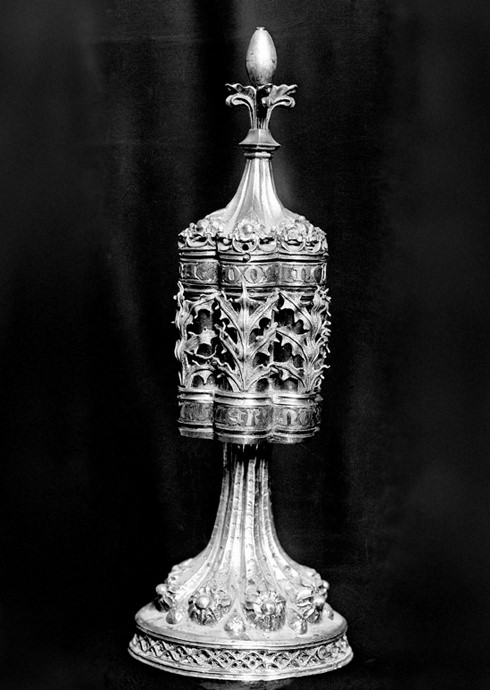
Reliquary of Myrrh (Missing) (ca. 1460).
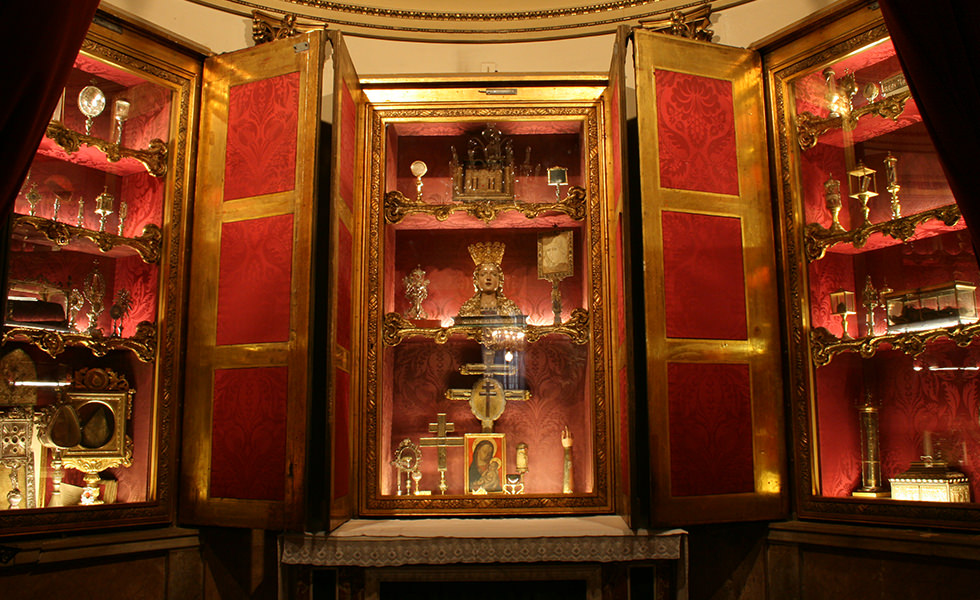
The Chapel of the Relics with the doors open
as it was until 2016.
Despite this great loss and those suffered in the sacking of the Cathedral on 21 July, 1936, many relics were preserved, now kept in more modest reliquaries, and some goldsmith pieces of great historical and artistic value.
Relics and Reliquaries
The relics of San Juan de Ribera and San Luís Bertránstrong> stand out, a hand that is the only part of his body that is preserved intact; there are also others of recent Valencian saints and beatified people.
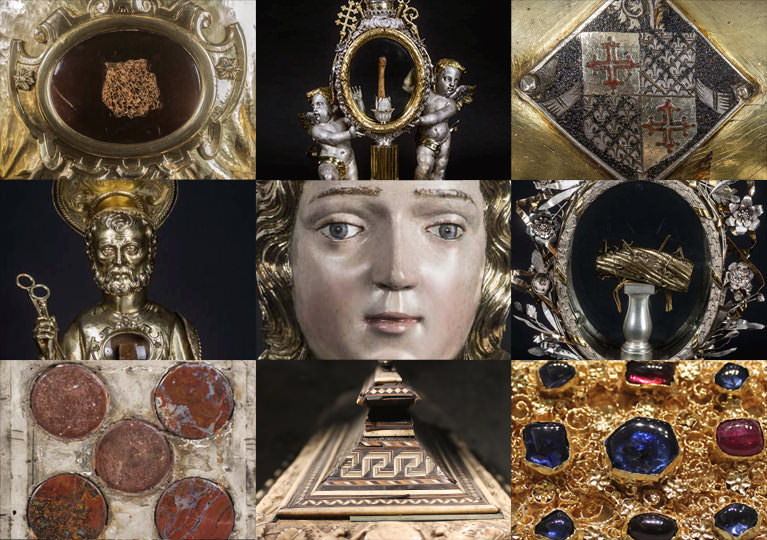
Of the old silver busts, only one of great beauty has remained, from the 15th century, with the image of the Blessed Virgin Mary. Among a varied sample of small reliquaries, there are the chests called the Agates and the Embriacchi, sent from Rome with relics by Pope Callixtus III.
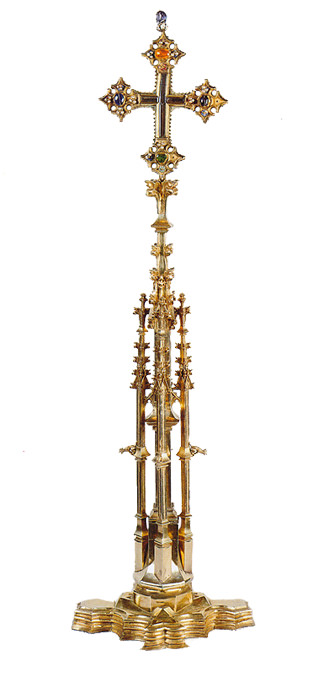
Lignum Crucis
Hohenstauffen
reliquary.
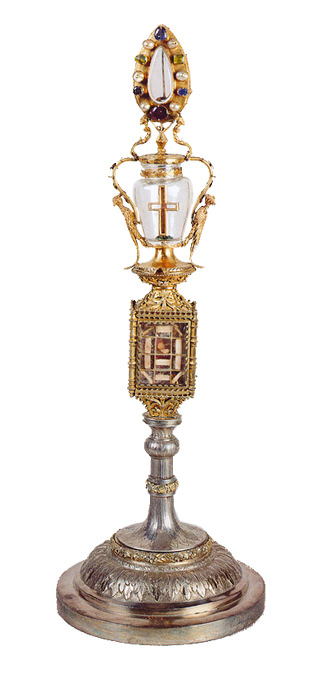
Jaume Castello’s
spine reliquary.
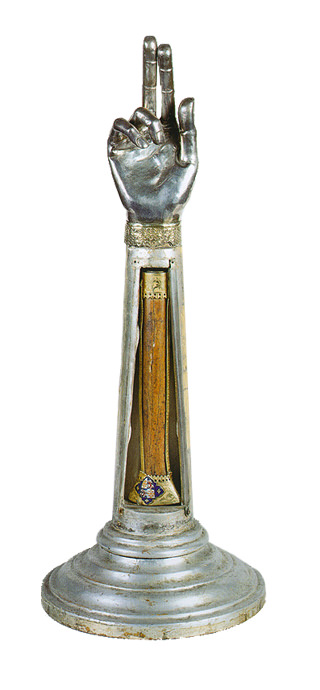
Reliquary of the Arm of Saint George of the Queen of Cyprus.
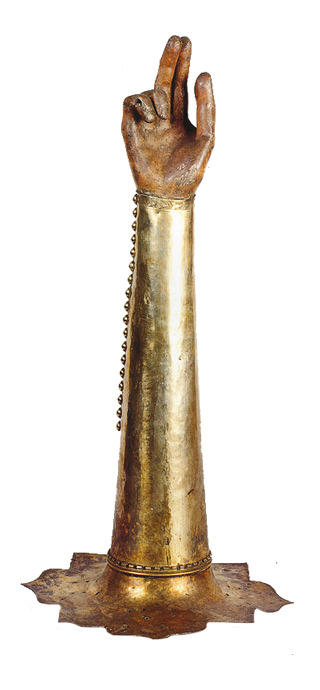
Reliquary
of St. George’s
arm.
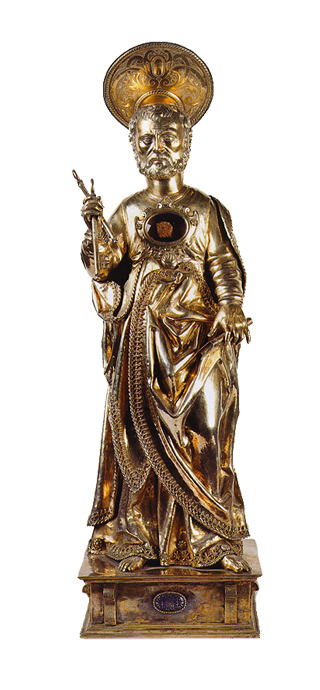
St. Peter’s
reliquary.
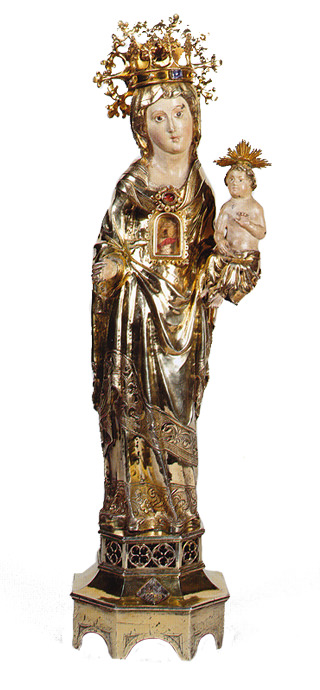
Madonna
and Infant Jesus
reliquary.
Reliquary of the kings of Aragon
These reliquaries are the ones with the greatest historical value, as they were in the chapels of the itirenant court of the kings of Aragon, in Zaragoza, Barcelona.
Finally they were in the Royal Palace of Valencia, from where they were taken to the Cathedral in 1437 by order of Alfonso V the Magnanimous; including a relic of the True Cross, of great size and arranged in the shape of a patriarchal cross and another inside a beautiful Gothic tower-shaped reliquary.
The Chapel of Relics
At the back of the Sacristy, behind a neoclassical lintel, is the chapel of the relics, circular in shape, where there are three large cabinets that kept the relics of the Cathedral.
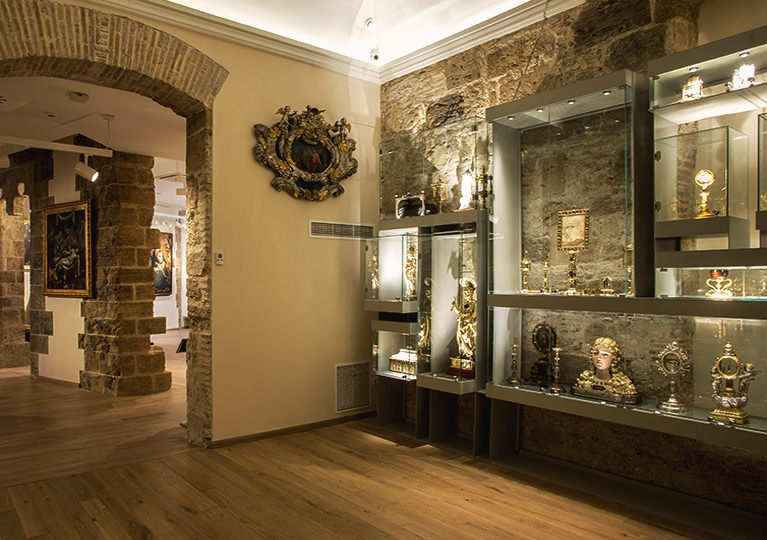
Since 2016, with the inauguration of the new Valencia Cathedral Museum, most of the relics has been preserved and exhibited in the ninth hall of the Museum.
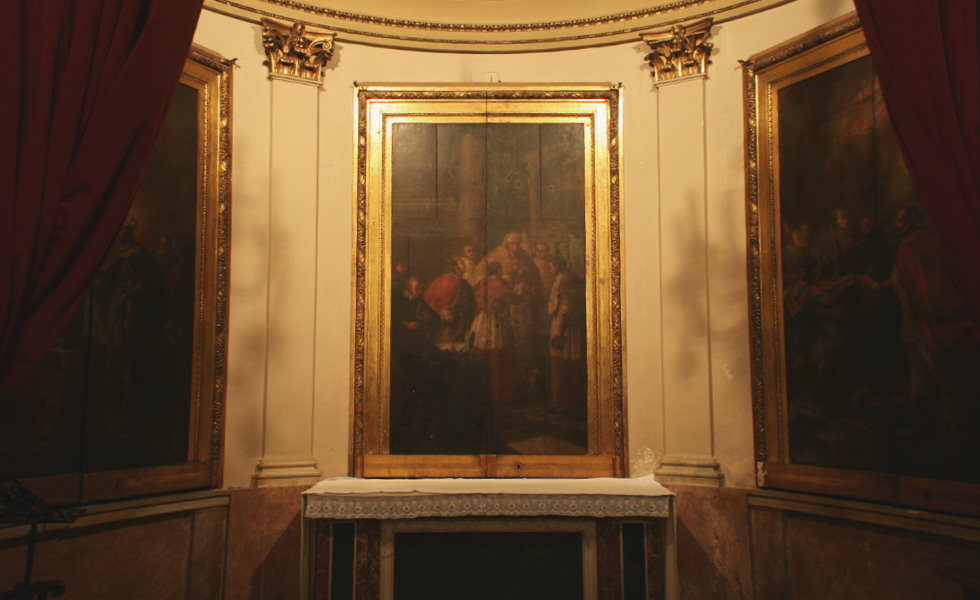
The Chapel of the Relics
with the doors closed.
The scenes are the work of the painter Miguel Parra (1780 - 1846)
The scenes on the doors
On its doors are represented the scenes of the delivery of the relic of the Holy Thorn by Saint Louis of France, that of the Holy Chalice (it was kept in the central cabinet until 1916) and that of the other relics of the House of Aragon by Alfonso V the Magnanimous.
The scenes on the doors are the work of the painter Miguel Parra (Valencia, 1780 Madrid, 1846)
The Reliquary in the Museum
Discover the reliquary of the Crown of Aragon and more magnificent works exhibited in the reliquary hall of the Museum.
In this space, dedicated to goldsmithing, the preserved pieces of the reliquary of the kings of Aragon are displayed, deposited in this cathedral by King Alfonso V the Magnanimous in 1437.
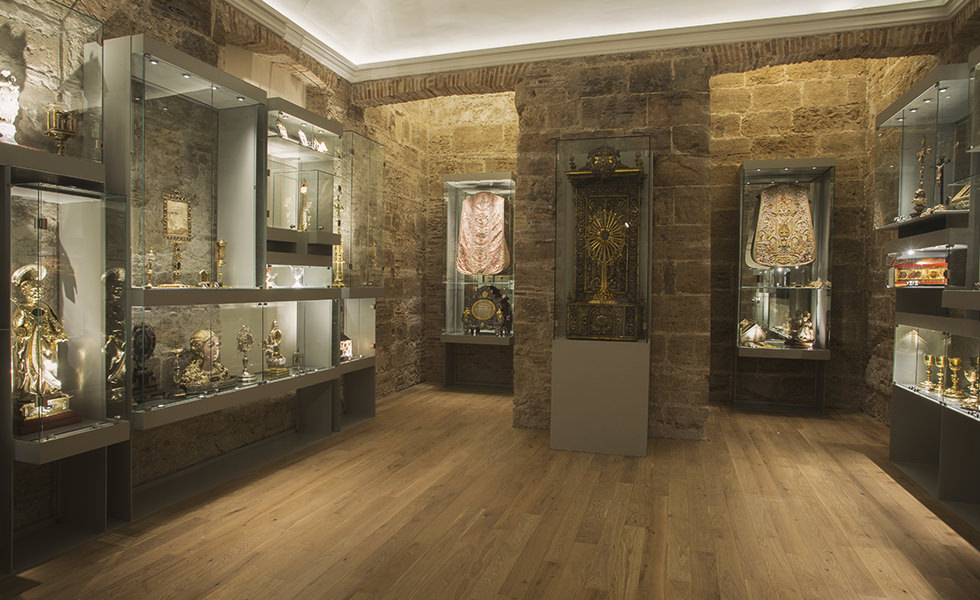
The reliquary hall.
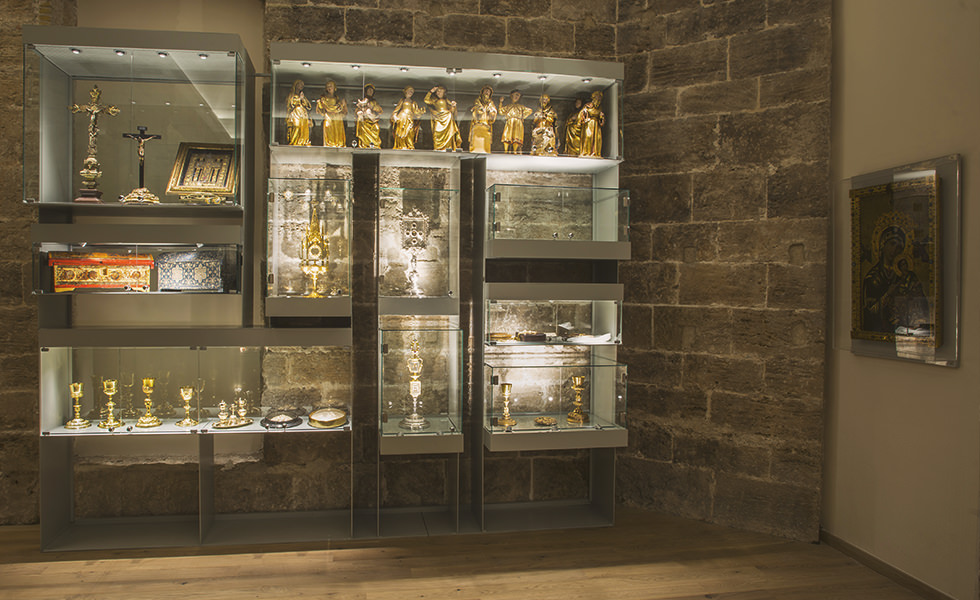
The reliquary hall.
The Reliquary Hall
One of the robust buttresses of the cathedral, from the first stage of its construction in the 13th century, centres this room, whose stone walls have now been brought to light.
The reliquary room is located in the ninth hall, second floor. You can discover more about the museum at www.museocatedralvalencia.com