Valencià
 Español
Description
of the organ
The music of the CathedralThe present organ
The present organ dates back to 2015, although a fairly high percentage of the pipework comes from the previous organs of Ibach (1860), Amezua (1888), Palop (1912) and Walcker (1948).
The last renovation-reconstruction was carried out by the French organ builder Jean Daldosso, following a symphonic-romantic aesthetic.
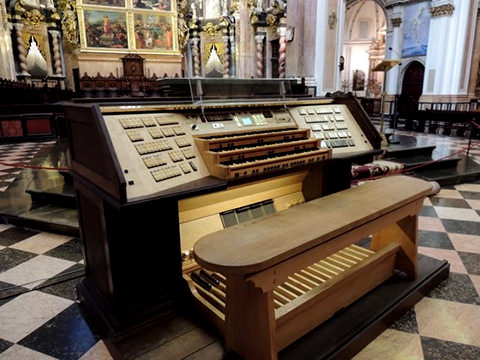
Present console. Jean Daldosso. (2015)
The design of the instrument is inspired by the execution of the English organ builder John Compton, where each set of tubes can be used at different heights (Unit System).With a total of 24 sets arranged in panels of 83 notes, the Valencia Cathedral organ, despite not being huge, offers a colour palette that is very rich in shades.Each of their sets translates into at least three records on the console, that is, a 16’ and a 4’ can be gotten from an 8′, due to the size of the panels. In this way, the 24 juegos are tripled in possibilities from the console.
Another important aspect of the instrument is the strong harmonization and the use of very high air pressures. All these registers are controlled from a mobile console, through an electrical transmission, which offers all the advances of the 21st century technology. The organ has nearly 2,500 pipes divided into three 61-note keyboards (C-c’’’’) and a 32-note pedalboard (C-g’’), three boxes (Accompaniment, Solo and Tuba), 99 registers on the console and a variety of attachments and accessories.
All this makes it a very complete organ, both for liturgical celebrations and for concert activities. Among the most remarkable aspects is its perfect suitability for improvisation, very much in line with its construction style.
Description
I. Grand-Choeur
- Grand Diapason16’
- Corno dolce16’
- Corno celeste16’
- Violoncelle16’
- Violoncelle celeste16’
- Voix celeste16’
- Diapason Magna8’
- Diapason Tenor8’
- Principal8’ (2h)
- Diapason Magna4’ (2h)
- Flûte harmonique8’
- Corno dolce8’
- Corno celeste8’
- Salicional8’
- Unda maris8’
- Voix celeste8’
- Bourdon8’
- Gros Nazard5’ 1/3
- Corno dolce4’
- Corno celeste4’
- Salicet4’
- Voix angélique4’
- Voix celeste4’
- Flûte à cheminée4’
- Grosse Tierce3’ 1/5
- Grande Septième2’ 2/7
- Violino2’
- Grande Neuvième1’ 7/9
- Plein Jeu6-7 h
- Harmonia Etherea3h
- Tuba Magna16’
- Bombarde16’
- Tuba Mirabilis8’
- 1ère Trompette8’
- 2ème Trompette8’
- Tuba Clarion4’
- Clairon4’
II. Grand-orgue
- Principal16’
- Violoncelle16’
- Bourdon16’
- Diapason Magna8’
- Diapason Tenor8’
- Principal8’ (2h)
- Corno dolce8’
- Corno celeste8’
- Flûte à cheminée8’
- Diapason Magna4’
- Diapason Alto4’
- Principal4’ (2h)
- Flûte harmonique4’
- Salicet4’
- Diapason Soprano2’
- Principal2’ (2h)
- Mixture3 h
- Basson16’
- Trompette8’
- Clarinette8’
- Clairon4’
III. Récit
- Corno dolce16’
- Quintaton16’
- Salicional8’
- Bourdon8’
- Quintaton8’
- Unda maris8’
- Voix celeste8’
- Flûte à cheminée4’
- Nazard2’ 2/3
- Octavin2’
- Violino2’
- Tierce1’ 3/5
- Septième1’ 1/7
- Neuvième8/9’
- Piccolo1’
- Harmonia Etherea3 h
- Tuba Magna16’
- Tuba Mirabilis8’
- Trompette8’
- Basson-Hautbois8’
- Voix humaine8’
- Tuba Clairon4’
Pédale
- Bourdon32’
- Corno dolce32’
- Flûte16’
- Soubasse16’
- Corno dolce16’
- Diapason Magna8’
- Principal8’
- Flûte8’
- Bourdon8’
- Flûte4’
- Octave4’
- Flûte2’
- Contre-trombone32’
- Contre-basson32’
- Tuba Magna16’
- Bombarde16’
- Tuba Mirabilis8’
- Trompette8’
- Tuba Clarion4’
Accessories
- Pedal couplingsG-Ch, GO, Réc
- Manual couplingsInversión I-II, II/I, III/I, I/II, III/II, I/III, II/III, Melodic soprano III/II, Melodic bass P/II
- SlotsAccompagnement, Solo and Tuba.
- Connection for the slotsI/II, III/II, I+II/III
- Crescendo general
- Sforzando II/I, Sforzando III/I
- 2 types of sostenuto for the three keyboards and pedal
- Tremoloone for the slot of the Solo and the other for the slot of the Accompagnement.
- Adjustable partition for pedal
- Electronic combiner ELTEC, Trapsound and MIDI