Valencià
 Español
History of the
Organs
Music of the Valencia CathedralThe organs of the Cathedral
One of the main elements of any Catholic cathedral is the pipe organ. Normally, in addition to constituting one of the cathedral’s most monumental works of art, like a true altarpiece, its true mission is the regular background music of the celebrations that make up the liturgical calendar.
View history and introduction
The first documents that testify to the existence of an organ in the Cathedral of Valencia date from the end of the 14th century.
The election of Popes Calixtus III (1455-1458) and Alexander VI (1492-1503), both belonging to the Borgia family, would exert a great artistic influence in the city and a growing taste for the Italian style.
The cathedral enjoyed excellent instruments throughout the 15th century, even being taken as an example for the creation of instruments in other Spanish cathedrals, such as the one of Zaragoza.
The large pipe organ.
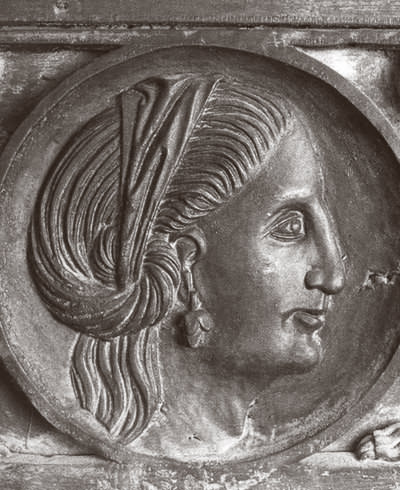
Medallions of the frieze of the larger entablature.
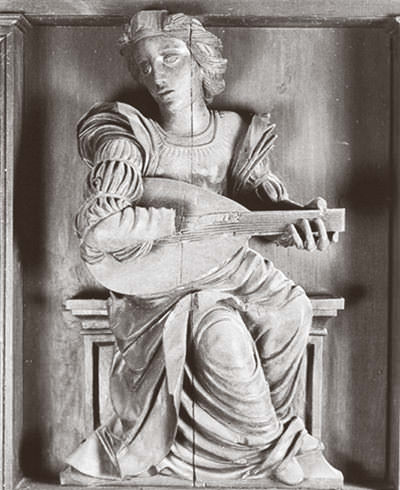
Limewood works by carver Jaume Vicent. Designed by Fernando Yáñez.
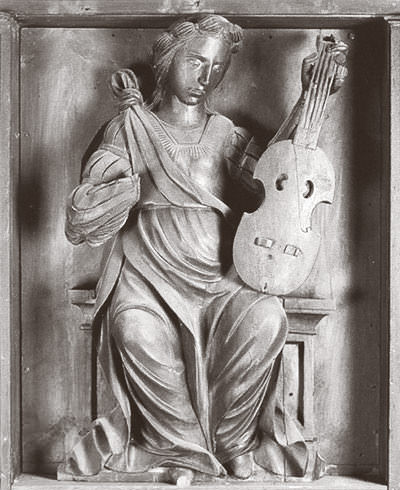
Limewood works by carver Jaume Vicent. Designed by Fernando Yáñez.
However, the history of the organs that have lasted until the 20th century began in 1510-1515 with the construction of the Renaissance organ by Pere Andreu Teixidor and Diego Ortiz, as far as the musical part is concerned, and Fernando Yáñez de la Almedina and Fernando Llanos, regarding the design and decoration of the box.
This organ, with a monumental appearance and a box worthy of the praise and admiration of all those who could contemplate it in later centuries, served as a container for later instruments.
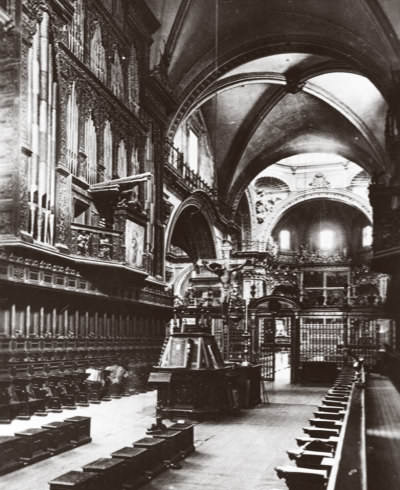
Since the 16th century, the cathedral had two organs. Both instruments were located in the choir that extended the length and width of the first two arches of the central nave:
“l’orgue gran” (on the left side or “Precentor’s choir”) and “l’orgue xic” (on the right side or “Bishop’s choir”), according to the nomenclature of the preserved documentation.
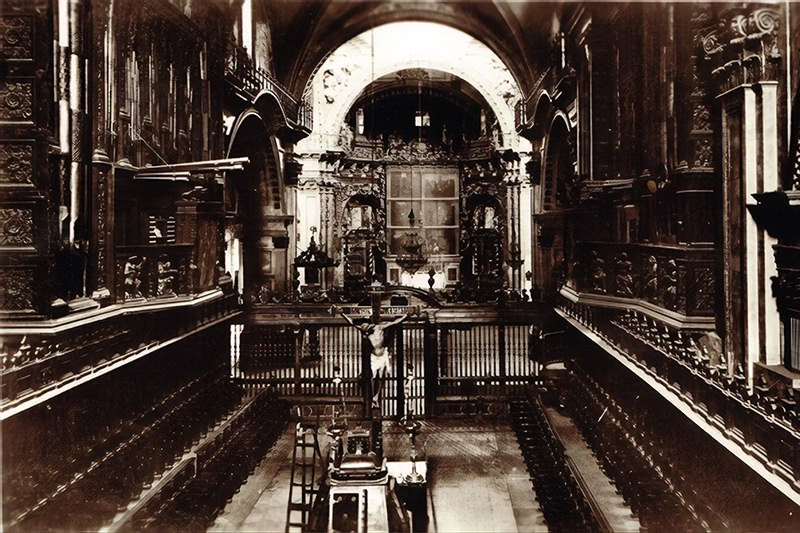
The central choir.
During the following centuries, “l’orgue gran” underwent numerous alterations: Antoni Llorens and Joan Olius (1632-1635) and Nicolás Salanova (1720-1723) refurbished it according to a more baroque aesthetic.
In 1777, as part of the renovation of the interior of the cathedral in the neoclassical style, the choir and organs were moved one arch further back, towards the main door or “Iron Gates”.
In the 19th century, the organ builders Ibach (1856-1860) and Juan Amezua (1886-1888) rebuilt it following the romantic aesthetic of the moment.
Finally, in 1942, within the integral restoration works of the cathedral, the chapter decided to dismantle the central choir to gain greater visibility. With the dismantling of the choir the two organs that flanked it were also disassembled.
The choir moved to the current place, in the main chapel, and with it also the organ.
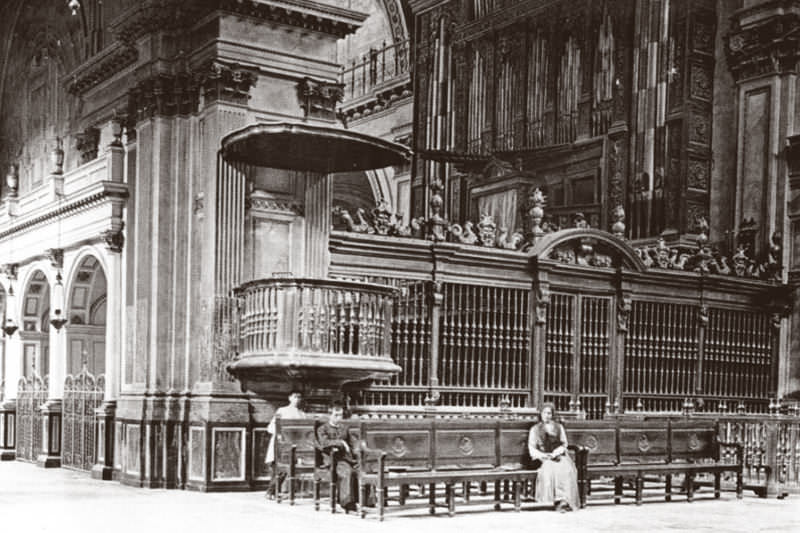
View of the choir (h. 1915)
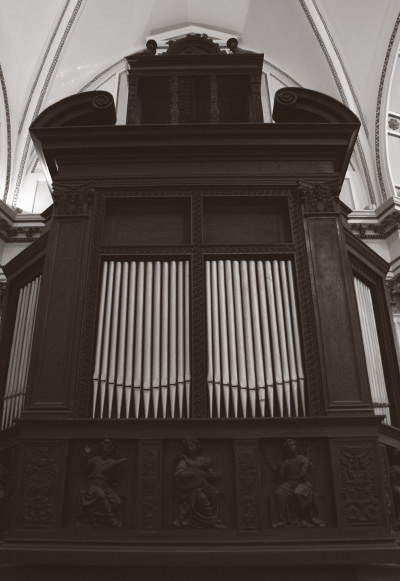
The organ
before its renovation (2007)
In 1948 the organ built by the German house E. F. Walcker & Cia with a clearly romantic aesthetic was inaugurated. However, this instrument soon began to present problems in its operation. In 1981, Gabriel Blancafort made a renovation of Walcker’s instrument giving it a more neoclassical aesthetic.
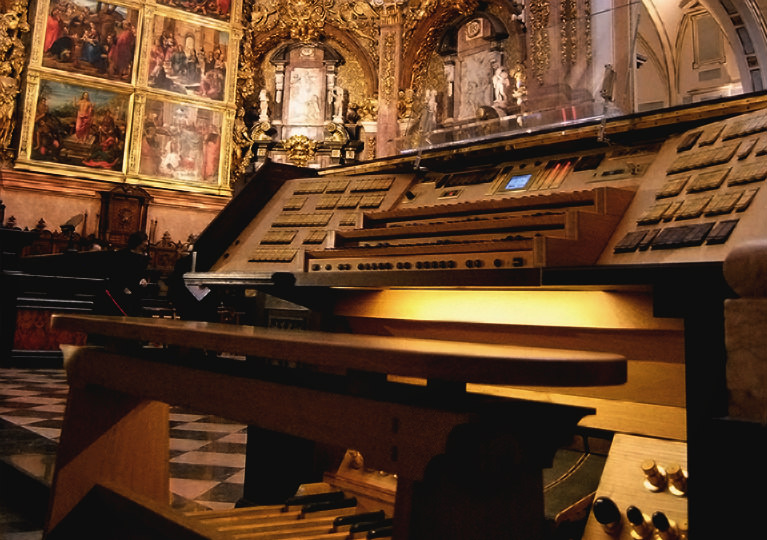
Recently, in 2015, the organ has been completely rebuilt by the French organ builder Jean Daldosso within a romantic-symphonic aesthetic.
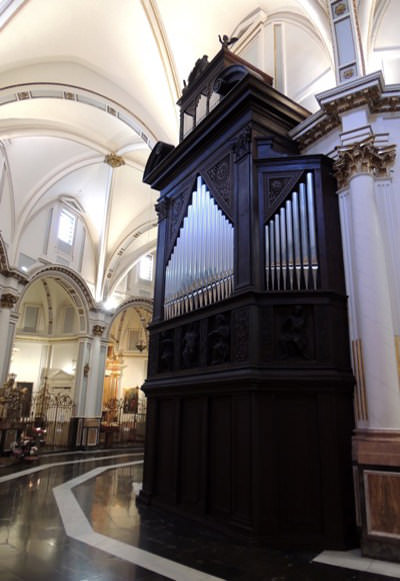
Present organ. Jean Daldosso. (2015)
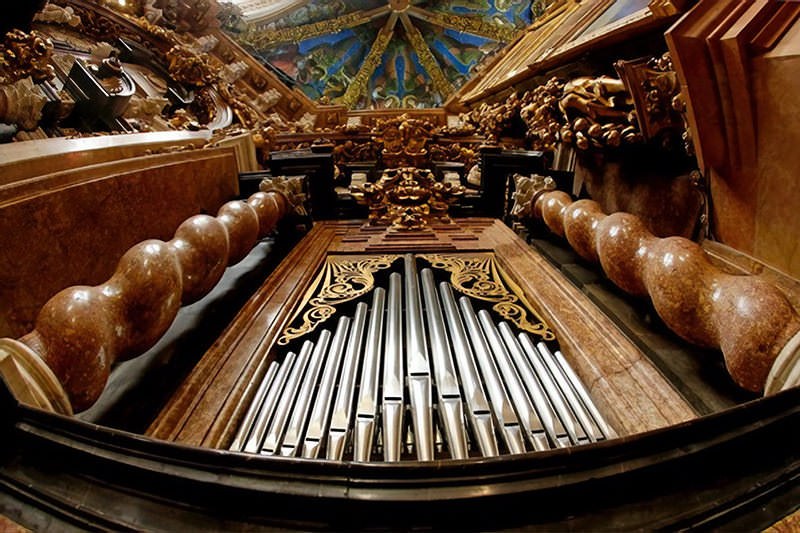
Present organ. Jean Daldosso. (2015)
Since then, the Valencia Cathedral organ has become a benchmark of its kind, and has hosted organists of great international fame within the cathedral’s own seasons, as well as within the festival “The Organ in Cathedrals” of the Centro Nacional de Difusión Musical (CNDM), unit of the Ministry of Education, Culture and Sports.