Valencià
 Español
The History
The Holy Chalice of the Lord's SupperThe Tradition
of the First Centuries
Tradition tells us that it is the same Vessel that the Lord used at the Last Supper for the institution of the Eucharist.
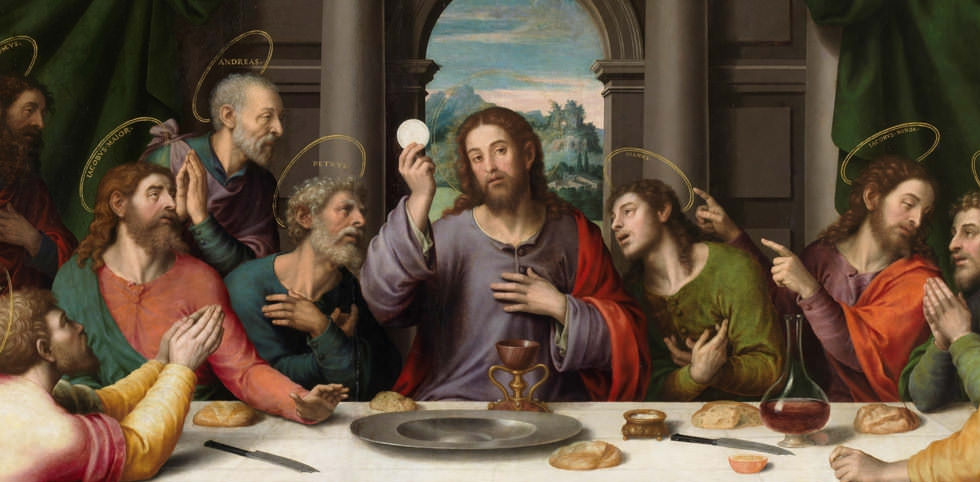
Detail of “The Last Supper”, oil on panel, Juan de Juanes, 16th century.
The Chalice was brought to Rome by Saint Peter and was preserved by the following Popes until Saint Sixtus II.
The presence of the Holy Chalice in Rome is revealed in the phrase of the Roman Canon mentioned above: “I take this glorious Chalice”, hoc praeclarum calicem. An admiring expression that we do not find in other ancient anaphoras, and we cannot forget that the Roman Eucharistic prayer is the Latin version of another one in the Greek language, since this was the language of the Church of Rome until Pope Saint Damasus in the 5th century.
In order to safeguard the Holy Chalice from the persecution of the Emperor Valerian, Saint Sixtus II, through his deacon Saint Lawrence, native of Spain, sent it to Huesca in the 3rd century.
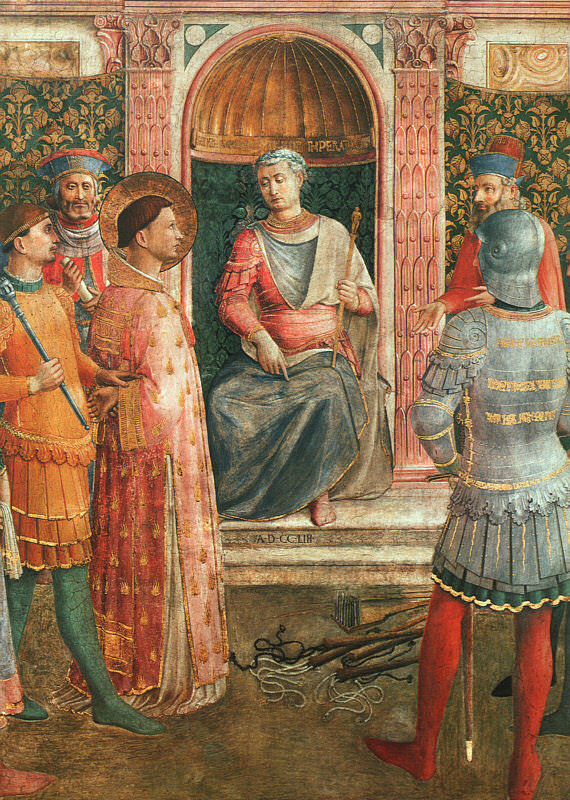
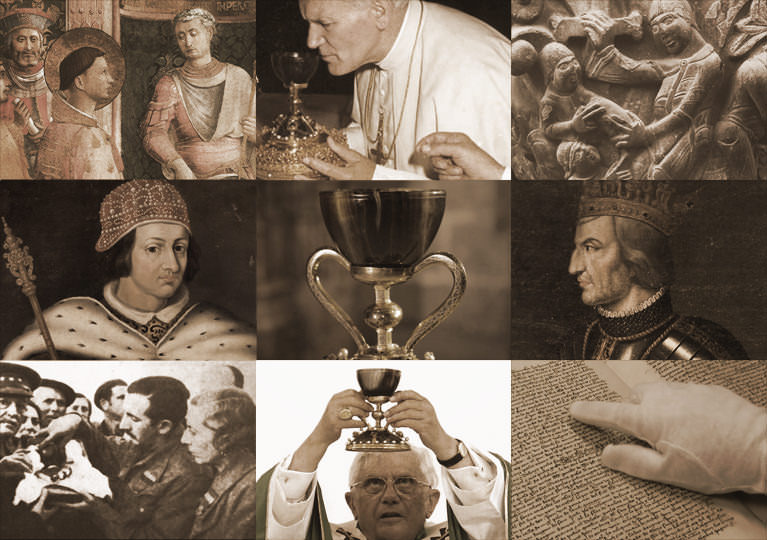
Lawrence facing Valerian,
detail from a fresco by Fra Angelico,
c. 1447–50
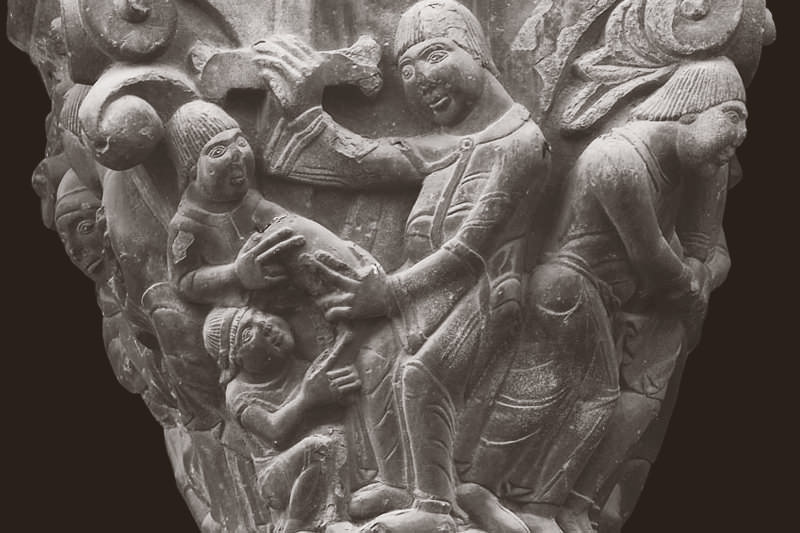
Saint Lawrence delivering the Holy Chalice,
in a capital of the “Lonja chica” of the Jaca Cathedral
12th century
The Holy Chalice in Spain
During the Muslim invasion, since 713 AD, the chalice was hidden in the Pyrenees region, after having been in Yebra, Siresa, Santa María de Sasabe (today San Adrián), Bailio and, finally, in the monastery of San Juan de la Peña (Huesca), where a document (1071) refers to a precious chalice made of stone.
The relic was handed over to the King of Aragon in 1399, Martin the Human who kept it in the Aljaferia Royal Palace of Saragossa and then, until his death, in the Royal Palace of Barcelona in 1410. The Holy Chalice is mentioned in the inventory of his assets 1.
1. Manuscript 136 of Martin the Human. Archive of the Aragon Crown. Barcelona, where the history of the sacred cup is described.
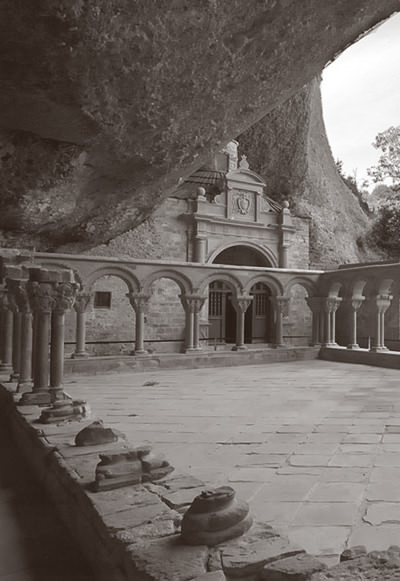
Cloister of the monastery of San Juan de la Peña.
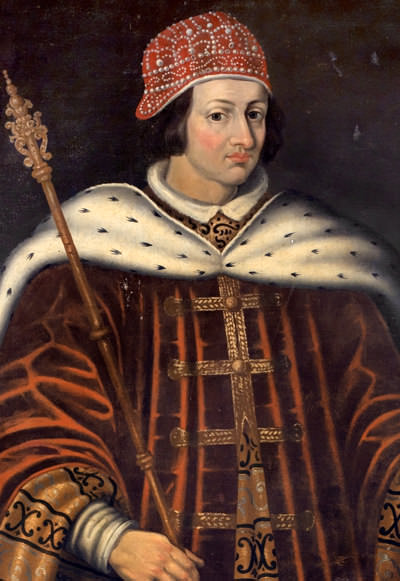
Detail of Martín I The human,
king of Aragon
Oil on canvas.
(1634)
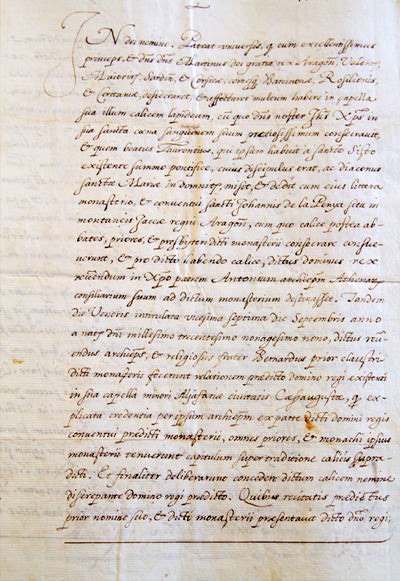
Copy of the document of the Archive of the Aragon Crown by which Martín I the Human receives the Holy Chalice.
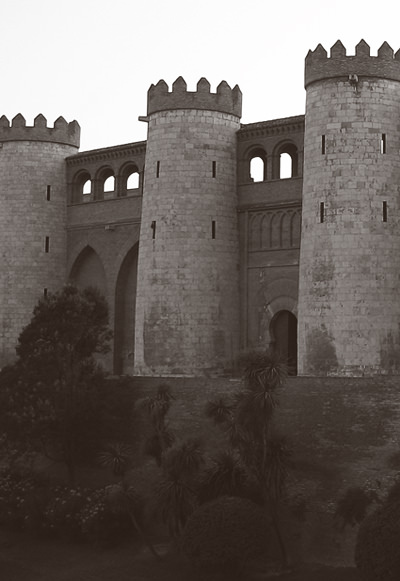
Aljafería
Royal Palace
of Zaragoza.
Towards 1424, the second successor of Mr. Martín, King Alfonso the Magnanimous took the royal reliquary to the Valencia Palace, and on the occasion of this King’s stay in Naples, it was delivered with the other royal relics to the Valencia Cathedral in 14372.
2. Volume 3.532, fol. 36 v. Cathedral Archive.
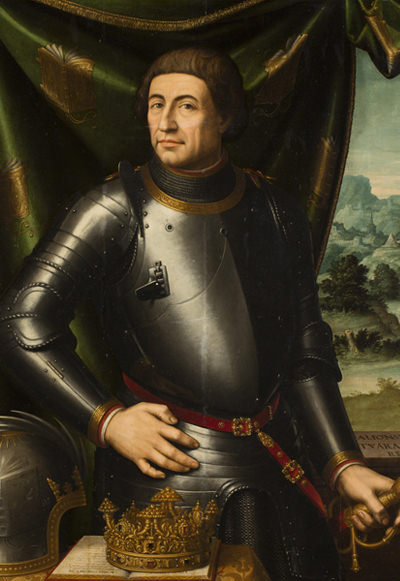
Portrait of the monarch Alfonso V, by Juan de Juanes,
(1557, oil on panel, Museum of Zaragoza)
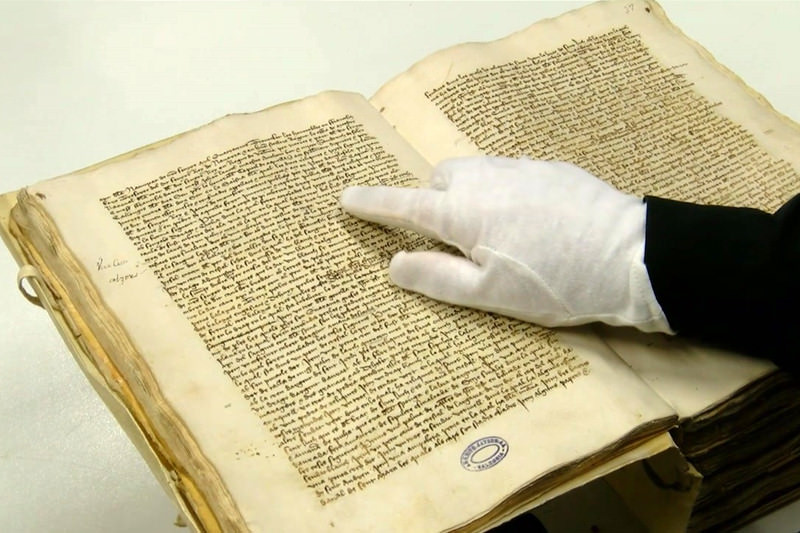
Inventory of the relics of the royal reliquary of the Crown of Aragon, deposited by Alfonso the Magnanimous in the cathedral of Valencia in 1437 Archive of the Valencia Cathedral
In the Valencia Cathedral
It was preserved and venerated for centuries among the relics of the Cathedral, and until the 18th century. it was used to contain the consecrated form in the “monument” of Holy Thursday.
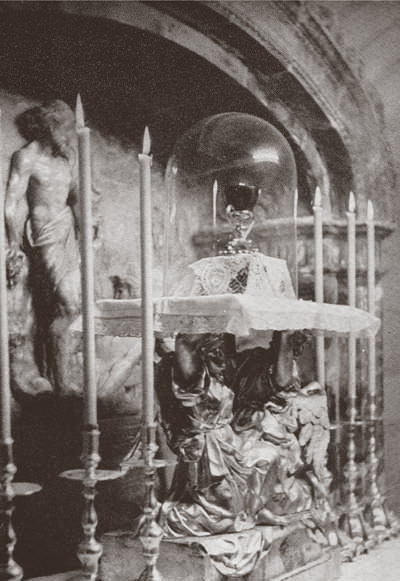
The Holy Chalice exposed in the Chapel of the Resurrection.
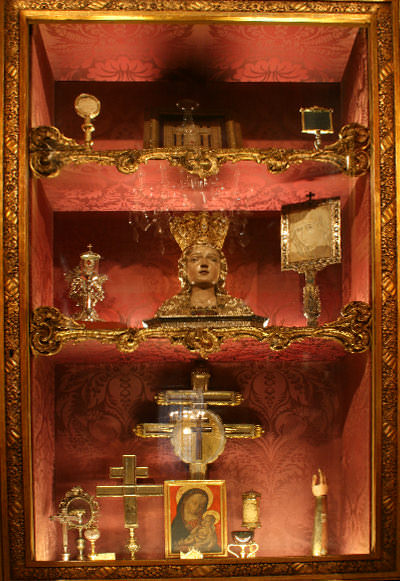
The relic cabinet where the chalice was kept in the Chapel of the relics.
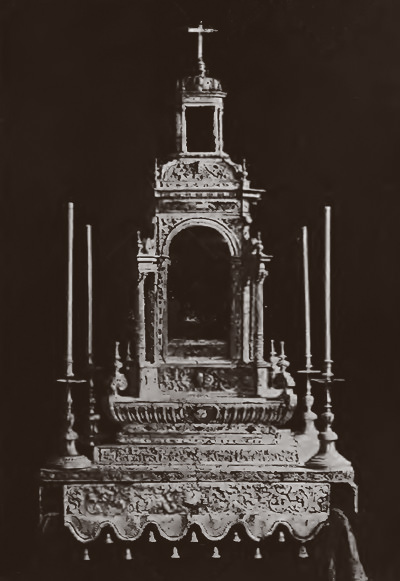
Tabernacle – Exhibitor
(disappeared during the civil war)
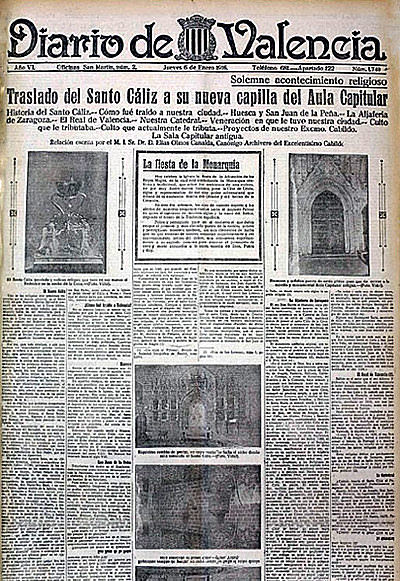
Newspaper announcing
the decision to move and exhibit the Cup.
In 1916, it was finally housed in the old Chapter House, fitted out as the Chapel of the Holy Chalice. Precisely this permanent public exhibition of the sacred relic, made it possible to disseminate its existence and knowledge, much reduced while it remained saved in the reliquary of the cathedral.
Two “exiles”
During the Independence War, between 1809 and 1813, the chalice was taken to Alicante, Ibiza and Palma de Mallorca, escaping from the rapacity of the Napoleonic invaders and during the civil war (1936-1939) it remained hidden in the town of Carlet.
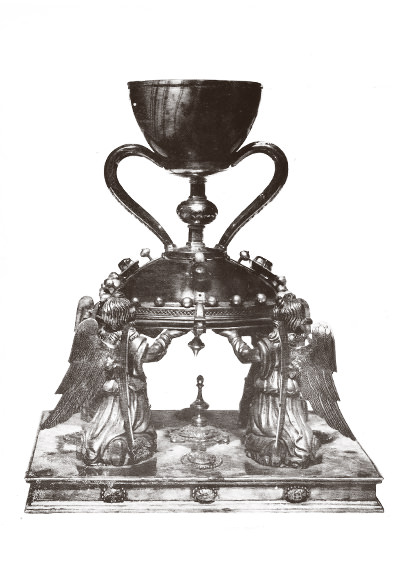
The chalice on the base destroyed on July 21, 1936 in the assault on the Cathedral.
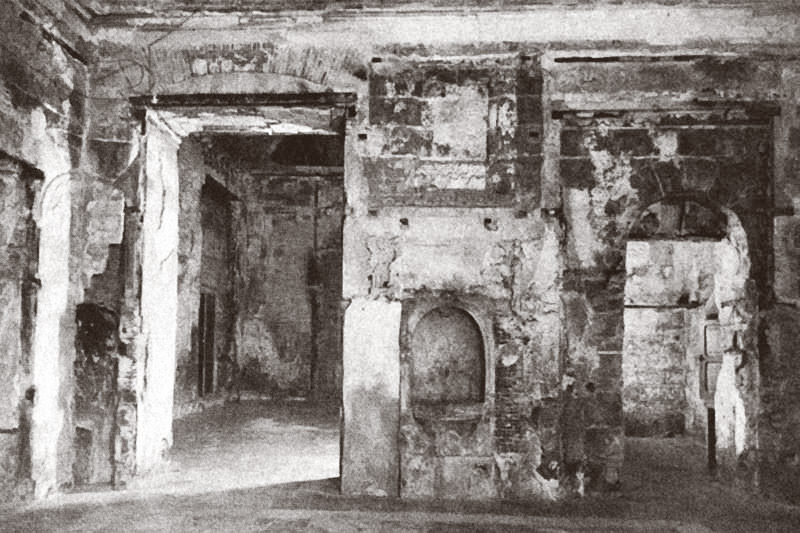
Wall in the house of Carlet where the chalice remained hidden between 1937 and 1939.
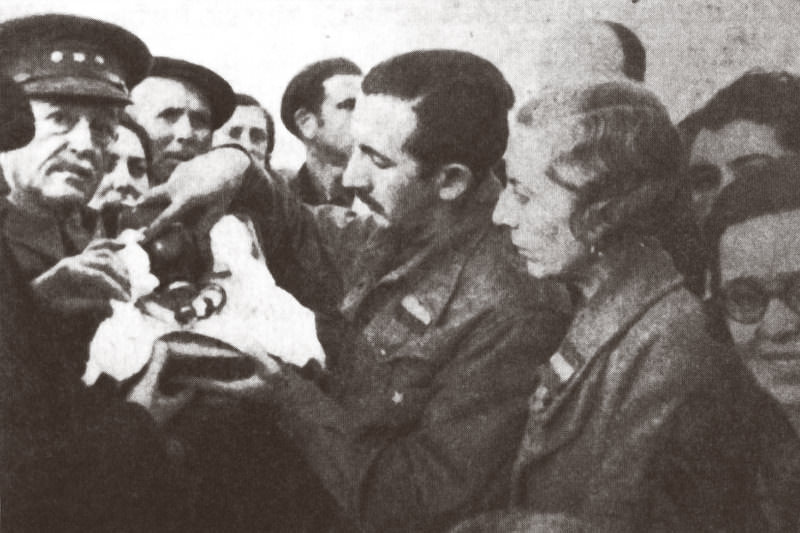
On March 30, 1939, the Holy Chalice could return to the Cathedral after the Civil War ended.
At present
Beatus John XXIII granted plenary indulgence on the day of its annual feast, Pope John Paul II celebrated the Eucharist with the Holy Chalice during his visit to Valencia on November 8, 1982.
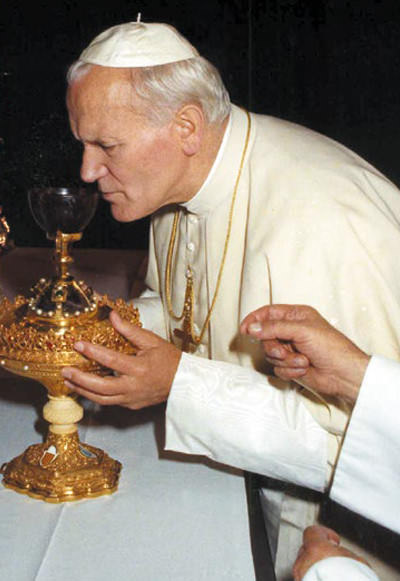
Pope John Paul II,
with the Holy Chalice
(1982)
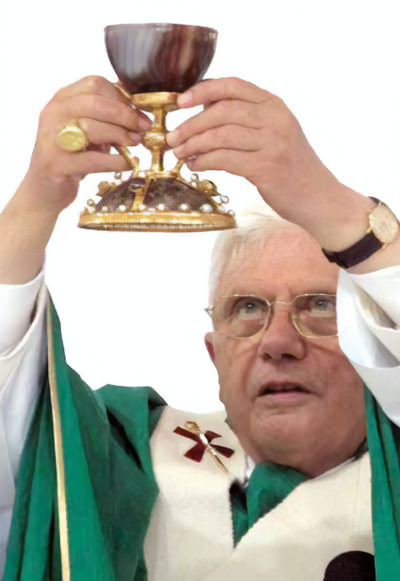
Pope Benedict XVI,
with the Holy Chalice
(2006)
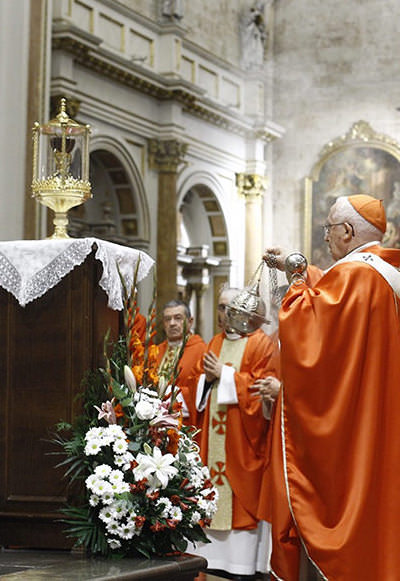
Archbishop Cañizares
with the Holy Chalice
(2015)
The same happened with His Holiness Benedict XVI who celebrated the Eucharist on the occasion of the V World Meeting of Families, on July 8, 2006; lastly, Pope Francis granted the celebration of an Eucharistic Jubilee Year in honor of the Holy Chalice, every five years beginning in 2015.